PyZeta Teaser

This teaser notebook shows some of the very basic functionality of PyZeta in terms of the scripting API. No real effort was made to follow best practices with respect to PyZeta-based applications in order to arrive at some interesting plots as fast as possible.

The goal here is to wet your appetit to start your own resonance adventure!

Imports

First some basic imports are needed - some of these would be abstracted away when programming with the highest-level enduser API.

[2]:
from typing import Final
from colorsys import hls_to_rgb

import numpy as np
import matplotlib.pyplot as plt

from pyzeal.rootfinders.rootfinder import RootFinder
from pyzeal.pyzeal_types.algorithm_types import AlgorithmTypes
from pyzeal.pyzeal_types.estimator_types import EstimatorTypes
from pyzeal.settings.json_settings_service import JSONSettingsService

from pyzeta.core.pyzeta_types.function_systems import FunctionSystemType
from pyzeta.core.pyzeta_types.map_systems import MapSystemType

from pyzeta.framework.initialization.initialization_handler import (
    PyZetaInitializationHandler,
)
from pyzeta.core.zetas.selberg_zeta import SelbergZeta
from pyzeta.core.pyzeta_types.integrals import OrbitIntegralType
from pyzeta.core.zetas.wzeta import WeightedZeta
from pyzeta.core.distributions.ruelle_distribution import RuelleDistribution

PyZetaInitializationHandler.initPyZetaServices()
# deactivate PyZEAL progress bar
JSONSettingsService().verbose = False

Hyperbolic Cylinder Resonances

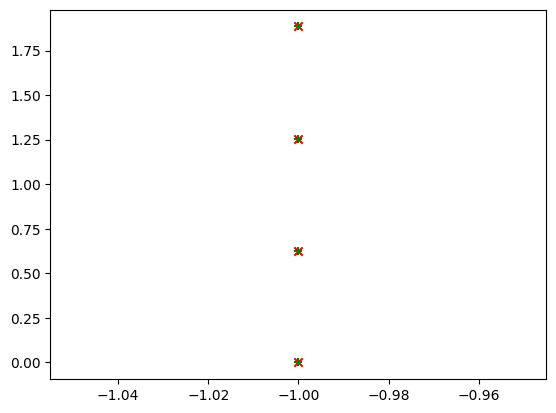
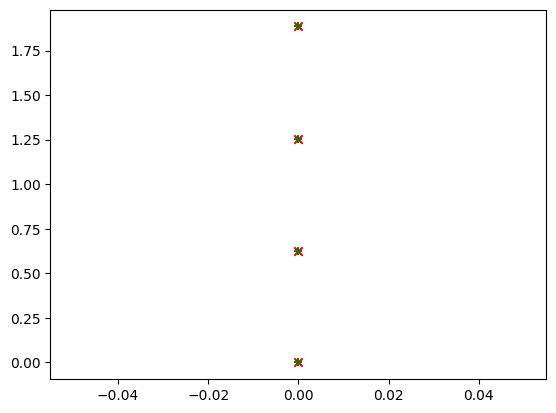
We begin by calculating some quantum resonances for the Schottky and flow adapted hyperbolic cylinders. These resonances are theoretically known to be located at \begin{equation} -\mathbb{N}_0 + \frac{2\pi\mathrm{i}}{\ell} \mathbb{Z} \end{equation} for \(\ell\) the width of the closed geodesic around the cylinder waist. Their respective multiplicities are always \(2\). Both representations should of course yield these values!

[2]:
initArgs = {"funnelWidth": 10.0, "rotate": False}
width = initArgs["funnelWidth"]
nMax = 10

for systemType, color, marker in zip(
    [
        FunctionSystemType.FLOW_CYLINDER,
        FunctionSystemType.HYPERBOLIC_CYLINDER,
    ],
    ["red", "green"],
    ["x", "+"],
):
    zeta = SelbergZeta(
        functionSystem=systemType,
        systemInitArgs=initArgs,
    )

    finder = RootFinder(
        f=lambda s: zeta(s, nMax=nMax),
        algorithmType=AlgorithmTypes.SIMPLE_ARGUMENT,
        estimatorType=EstimatorTypes.SUMMATION_ESTIMATOR,
    )

    finder.calculateRoots(
        reRan=(-0.4, 0.5), imRan=(-0.1, 2.2), precision=(3, 2)
    )
    for res, order in zip(finder.roots, finder.orders):
        print(f"resonance={res} --> order={order}")

    plt.scatter(finder.roots.real, finder.roots.imag, c=color, marker=marker)

resonance=1.885j --> order=2
resonance=-0j --> order=2
resonance=0.628j --> order=2
resonance=1.256j --> order=2
resonance=1.885j --> order=2
resonance=-0j --> order=2
resonance=0.628j --> order=2
resonance=1.256j --> order=2
_images/teaser_7_1.png

Next we repeat the experiment above but now for classical Pollicott-Ruelle resonances calculated from weighted dynamical determinants with constant weight. From the classical-quantum correspondence we know that these should coincide with the quantum resonances after a shift by \(-1\).

[6]:
# calculate classical resonances for Schottky and flow adapted cylinders
initArgs = {"funnelWidth": 10.0}
width = initArgs["funnelWidth"]
nMax = 10

for systemType, color, marker in zip(
    [
        MapSystemType.HYPERBOLIC_CYLINDER,
        MapSystemType.FLOW_CYLINDER,
    ],
    ["red", "green"],
    ["x", "+"],
):
    wzeta = WeightedZeta(
        mapSystem=systemType,
        systemInitArgs=initArgs,
        integralType=OrbitIntegralType.CONSTANT,
        integralInitArgs={},
    )

    finder = RootFinder(
        f=lambda s: wzeta(s, nMax=nMax),
        algorithmType=AlgorithmTypes.SIMPLE_ARGUMENT,
        estimatorType=EstimatorTypes.SUMMATION_ESTIMATOR,
    )

    finder.calculateRoots(
        reRan=(-1.4, -0.5), imRan=(-0.1, 2.2), precision=(3, 2)
    )
    for res, order in zip(finder.roots, finder.orders):
        print(f"resonance={res} --> order={order}")

    plt.scatter(finder.roots.real, finder.roots.imag, c=color, marker=marker)

resonance=(-1+1.256j) --> order=2
resonance=(-1-0j) --> order=2
resonance=(-1+0.628j) --> order=2
resonance=(-1+1.885j) --> order=2
resonance=(-1+1.256j) --> order=2
resonance=(-1-0j) --> order=2
resonance=(-1+0.628j) --> order=2
resonance=(-1+1.885j) --> order=2
_images/teaser_9_1.png

Funneled Torus Resonances

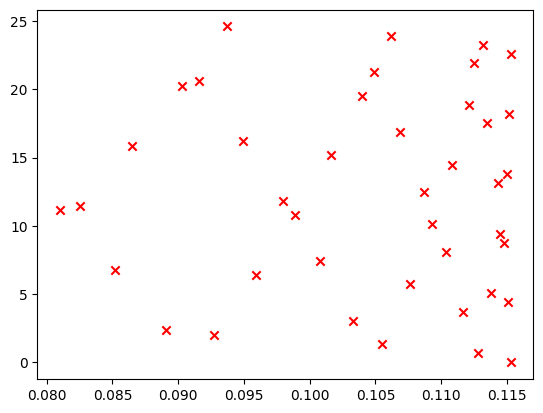
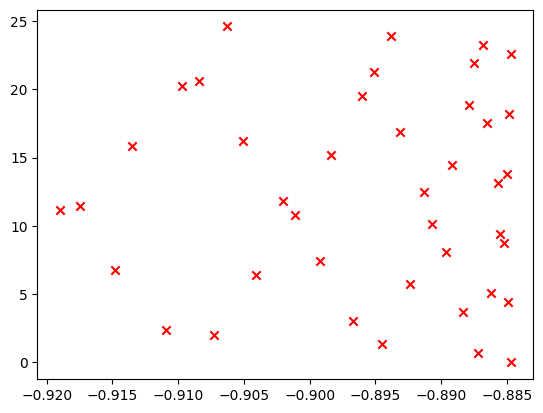
We finish our resonance demonstrations with the first couple of resonances for the funneled torus. These are already rather complicated and not known exactly but there exist previous numerical investigations in the literature with which we may verify our calculations.

Again both quantum and classical resonances are calculated and their correspondence can be used as a consistency check between dynamical determinants and Selberg’s zeta function.

[7]:
# calculate quantum resonances for non-geometric torus coordinate choice
initArgs = {"outerLen": 10.0, "innerLen": 10.0, "angle": np.pi / 2.0}
nMax = 6

systemType = FunctionSystemType.FUNNEL_TORUS
color = "red"
marker = "x"

zeta = SelbergZeta(
    functionSystem=systemType,
    systemInitArgs=initArgs,
)

finder = RootFinder(
    f=lambda s: zeta(s, nMax=nMax),
    algorithmType=AlgorithmTypes.SIMPLE_ARGUMENT,
    estimatorType=EstimatorTypes.SUMMATION_ESTIMATOR,
)

finder.calculateRoots(reRan=(0.08, 0.12), imRan=(-0.0, 25.0), precision=(3, 2))

plt.scatter(finder.roots.real, finder.roots.imag, c=color, marker=marker)
[7]:
<matplotlib.collections.PathCollection at 0x7fbe3a180cd0>
_images/teaser_12_1.png
[8]:
# calculate classical resonances for non-geometric torus coordinate choice
initArgs = {"outerLen": 10.0, "innerLen": 10.0, "angle": np.pi / 2.0}
nMax = 6

systemType = MapSystemType.FUNNEL_TORUS
color = "red"
marker = "x"

zeta = WeightedZeta(
    mapSystem=systemType,
    systemInitArgs=initArgs,
    integralType=OrbitIntegralType.CONSTANT,
    integralInitArgs={},
)

finder = RootFinder(
    f=lambda s: zeta(s, nMax=nMax),
    algorithmType=AlgorithmTypes.SIMPLE_ARGUMENT,
    estimatorType=EstimatorTypes.SUMMATION_ESTIMATOR,
)

finder.calculateRoots(
    reRan=(-0.92, -0.88), imRan=(-0.0, 25.0), precision=(3, 2)
)

plt.scatter(finder.roots.real, finder.roots.imag, c=color, marker=marker)
[8]:
<matplotlib.collections.PathCollection at 0x7fbe3a1a2710>
_images/teaser_13_1.png

Hyperbolic Cylinder Ruelle Distributions

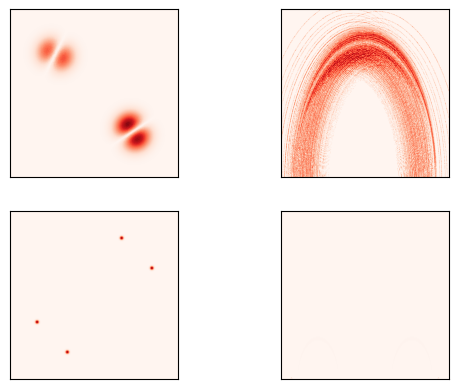
The genuinely new technique of PyZeta is the investigation of invariant Ruelle distributions via weighted zeta functions. The upcoming plots show such distributions both for the Schottky and the flow-adapted hyperbolic cylinder. These variants are calculated and visualized with two different methods namely restriction to the canonical Poincare section and pushforward to the canonical fundamental domain.

[13]:
# calculate Ruelle dist at delta-1 for Schottky and flow-adapted systems
FIRST_RESONANCE: Final[complex] = -1.0 + 0.0j

_, axs = plt.subplots(2, 2)

for i, integralType in enumerate(
    [OrbitIntegralType.POINCARE, OrbitIntegralType.FUNDAMENTAL_DOMAIN]
):
    for j, systemType in enumerate(
        [MapSystemType.HYPERBOLIC_CYLINDER, MapSystemType.FLOW_CYLINDER]
    ):
        ruelle = RuelleDistribution(
            systemType,
            systemInitArgs={"funnelWidth": 5.0},
            integralType=integralType,
            sigma=5e-2,
            numSupportPts=600,
        )

        firstDistribution = ruelle(
            np.array([FIRST_RESONANCE], dtype=np.complex128), nMax=7
        )[0]
        axs[j][i].imshow(
            np.abs(firstDistribution), cmap="Reds", origin="lower"
        )
        axs[j][i].set_xticks([])
        axs[j][i].set_yticks([])

plt.show()

_images/teaser_16_0.png

The results are quite homogeneous due to the decently large resolution \(\sigma\) as well as the associated resonance being the first at \(\lambda_0 = -1\). Nevertheless both plots show clearly the support within the fundamental intervals of the underlying systems.

Funneled Torus Ruelle Distributions

Finally we complement the invariant Ruelle distributions of the hyperbolic cylinder with similar examples but now for the funneled torus.

[5]:
# calculate Ruelle distribution beyond delta-1 for conventional torus params
HIGHER_RESONANCE: Final[complex] = -0.8847
systemType = MapSystemType.FUNNEL_TORUS
systemInitArgs = {"outerLen": 10.0, "innerLen": 10.0, "angle": np.pi / 2.00}
N_MAX = 7

poincareArgs = {
    "sigma": 1e-3,
    "refinementLevel": 0,
    "minusIndices": [1, 2, 3],
    "plusIndices": [0, 1],
}
fundamentalDomainArgs = {
    "sigma": 6e-2,
    "refinementLevel": 0,
}

_, (axs1, axs2) = plt.subplots(2, 4)

for i, axs in enumerate((axs1, axs2)):
    for j, (integralType, args) in enumerate(
        zip(
            [OrbitIntegralType.POINCARE, OrbitIntegralType.FUNDAMENTAL_DOMAIN],
            [poincareArgs, fundamentalDomainArgs],
        )
    ):
        ruelle = RuelleDistribution(
            systemType,
            systemInitArgs=systemInitArgs,
            integralType=integralType,
            numSupportPts=300,
            **args,
        )

        higherDistribution = ruelle(
            np.array([HIGHER_RESONANCE], dtype=np.complex128), nMax=N_MAX + i
        )[0]

        # create a phase-lightness representation of the distribution
        absoluteValue = np.abs(higherDistribution)
        argument = np.angle(higherDistribution)
        hue = (argument + np.pi) / (2 * np.pi) + 0.5
        lightness = 1.0 - 1.0 / (1.0 + absoluteValue**0.2)
        saturation = 0.8

        rgb = np.array(np.vectorize(hls_to_rgb)(hue, lightness, saturation))
        rgb = rgb.swapaxes(0, 2).swapaxes(0, 1)

        axs[2 * j].imshow(np.abs(1.0 - rgb), cmap="Reds", origin="lower")
        axs[2 * j].set_xticks([])
        axs[2 * j].set_yticks([])

        axs[2 * j + 1].imshow(
            np.abs(higherDistribution), cmap="Reds", origin="lower"
        )
        axs[2 * j + 1].set_xticks([])
        axs[2 * j + 1].set_yticks([])

plt.show()
_images/teaser_20_0.png
[10]:
# calculate Ruelle distribution beyond delta-1 for conventional torus params
HIGHER_RESONANCE: Final[complex] = -0.9998 + 9.12j
systemType = MapSystemType.FUNNEL_TORUS
systemInitArgs = {"outerLen": 10.0, "innerLen": 10.0, "angle": np.pi / 2.00}
integralType = OrbitIntegralType.POINCARE
N_MAX = 6

poincareArgs = {
    "sigma": 2e-3,
    "refinementLevel": 0,
    "minusIndices": [1, 2, 3],
    "plusIndices": [0, 1],
}

_, (axs1, axs2) = plt.subplots(1, 2)

ruelle = RuelleDistribution(
    systemType,
    systemInitArgs=systemInitArgs,
    integralType=integralType,
    numSupportPts=300,
    **poincareArgs,
)

higherDistribution = ruelle(
    np.array([HIGHER_RESONANCE], dtype=np.complex128), nMax=N_MAX
)[0]

# create a phase-lightness representation of the distribution
absoluteValue = np.abs(higherDistribution)
argument = np.angle(higherDistribution)
hue = (argument + np.pi) / (2 * np.pi) + 0.5
lightness = 1.0 - 1.0 / (1.0 + absoluteValue**0.2)
saturation = 0.8

rgb = np.array(np.vectorize(hls_to_rgb)(hue, lightness, saturation))
rgb = rgb.swapaxes(0, 2).swapaxes(0, 1)

axs1.imshow(np.abs(1.0 - rgb), cmap="Reds", origin="lower")
axs1.set_xticks([])
axs1.set_yticks([])

axs2.imshow(np.abs(higherDistribution), cmap="Reds", origin="lower")
axs2.set_xticks([])
axs2.set_yticks([])

plt.show()
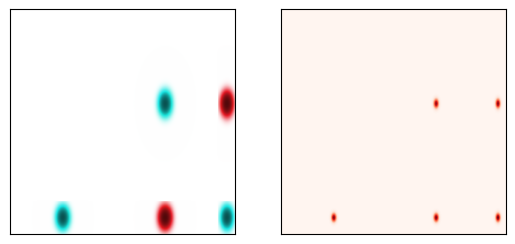
_images/teaser_21_0.png

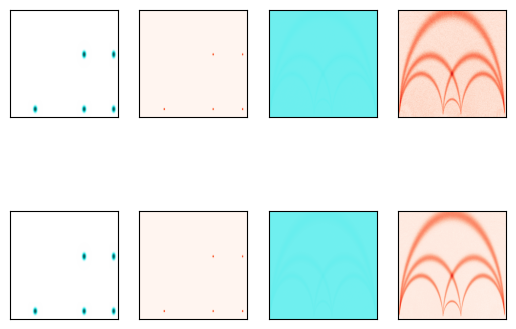
We calculated and plotted the same pair of Poincare/fundamental domain approximations for two subsequent cutoff values \(n_\mathrm{max}\) in the cycle expansion. This helps us verify that the distributions have indeed converged which beyond the first resonance is often difficult to make work without symmetry reduction. This is exactly the case for the fundamental domain variant in our second to last example which has just barely converged.

In practice it is much cleaner to verify convergence programmatically with one of the error estimators of PyZeta.